
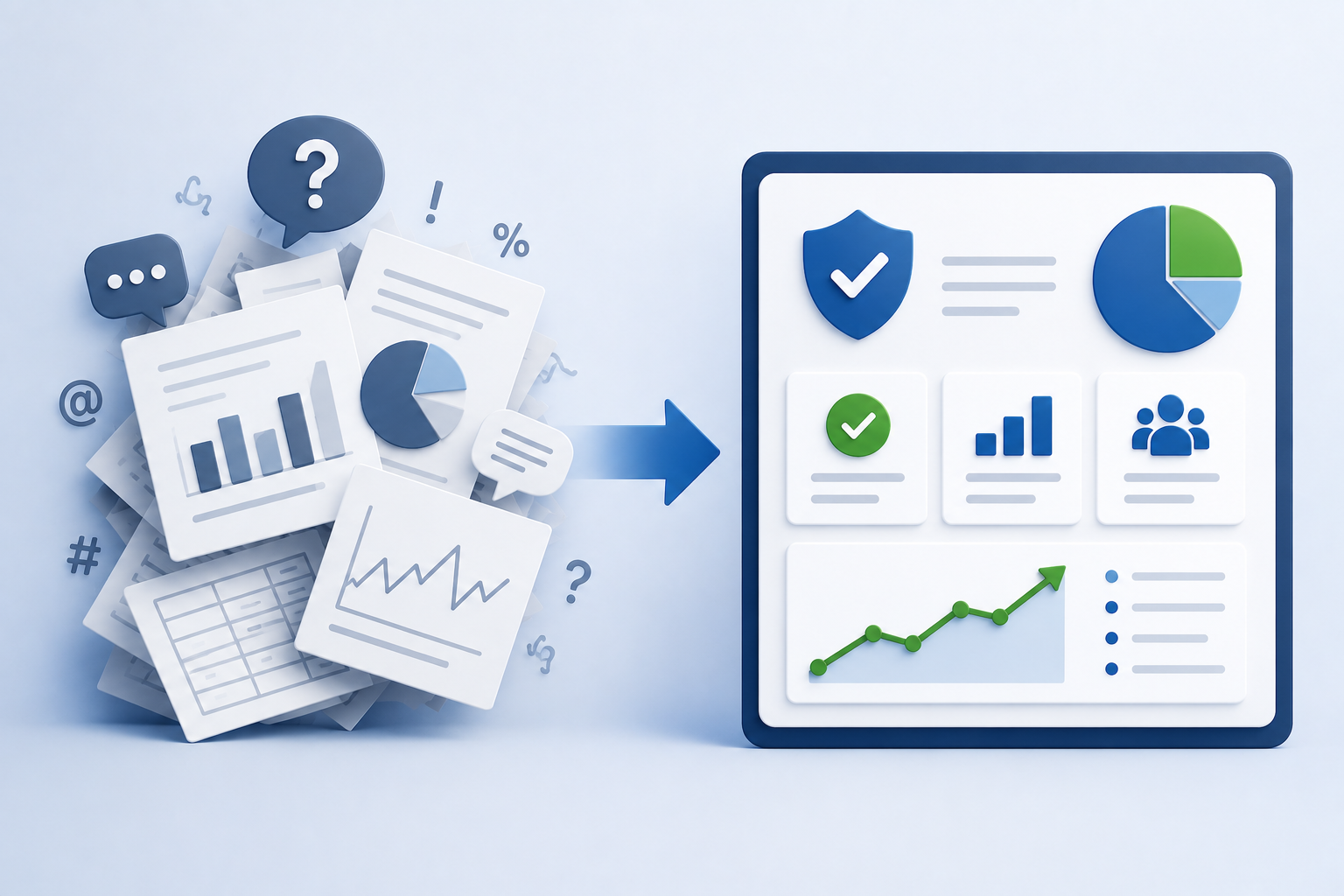
Ask any executive what they want from an IT update, and the answer is usually some version of the same thing: tell me if we’re safe, tell me if we’re spending wisely, and tell me if there’s something I need to worry about.
It’s not a complicated ask. Yet most IT reporting doesn’t answer any of those questions.
This is one of the most common and most underappreciated problems in IT. Not a lack of information, but a failure to translate it into something leadership can actually use. Most IT reporting is built for IT teams. It reflects how technical professionals think about their work, in systems, incidents, and metrics. But boards and leadership teams think in risk, budget, and strategy. When those two languages don’t connect, leadership disengages, decisions get made without full context, and IT becomes something that gets rubber-stamped rather than genuinely understood.
That gap matters more than most organizations realize. When leadership can’t evaluate IT health, they can’t prioritize it, budget for it, or escalate the right issues at the right time. The good news is that reporting problems are a fixable governance problem.
In this post, we’ll walk through what meaningful, business-focused IT reporting actually looks like, including the metrics that matter, how to communicate risk in plain language, and how TenisiTech helps bridge the gap between technical teams and executive audiences.
Built for the Wrong Audience: Why Most IT Reports Fail Leadership Teams
Most IT updates follow the same pattern: here’s how many tickets we closed, here’s our uptime percentage, here’s what we patched this month. These metrics are real and they’re trackable, but they don’t answer the questions that keep executives up at night.
Leadership teams aren’t asking how many helpdesk tickets were resolved. They’re asking whether their employees have what they need to do their jobs. They’re not asking for a list of patches applied. They’re asking whether the organization is protected against the threats they keep reading about in the news. And they’re certainly not asking for a technical breakdown of network configurations. They’re asking whether IT is aligned with where the business is headed.
When reports lead with the wrong metrics, a few things happen. Leadership tunes out, because the information doesn’t feel relevant to their decisions. They lose confidence in their IT partner, because the communication feels opaque rather than transparent. And over time, they stop asking hard questions, which means genuine risks go unexamined until something breaks.
The disconnect is well documented. According to NACD’s 2024 Board Practices and Oversight Survey, only 13 percent of directors rate their board reports as ‘extremely effective.’ That number points to a systemic problem: reporting built for the wrong audience.
Good IT reporting closes that gap. It meets leadership where they are, speaks in the language of business outcomes, and gives decision-makers the clarity they need to engage meaningfully.
The Right Questions: What Leadership Actually Needs IT Reporting to Tell Them
Before deciding what to include in an IT report, the more useful question is: what does leadership actually need to know? Most executives and board members are trying to get answers to some version of the following:
- Are we secure and compliant? Not in a technical sense, but in a practical one. Are we doing what we’re supposed to be doing, and are we protected against the risks that could disrupt the organization or expose us to liability?
- Are we spending the right amount, and getting value from it? IT spend is one of the harder budget lines to evaluate. Leadership needs to know whether the investment is producing outcomes, not just activity.
- What risks should we be aware of, and what’s being done about them? This is where most IT reporting falls short. Risk exists in every IT environment, and leadership deserves to understand it in plain terms, along with a clear picture of how it’s being managed.
- Is our technology supporting our strategic goals? IT decisions don’t happen in a vacuum. Leadership needs to know whether current systems and planned investments are aligned with where the organization is headed.
Good IT reporting answers these questions directly, before leadership has to ask.
The Metrics That Actually Matter
Meaningful IT reporting is about reporting the right things, framed in context that leadership can act on. These are the categories worth prioritizing:
Security posture and risk exposure. Rather than listing technical vulnerabilities, report on the organization’s overall risk level, the most relevant threats, and what’s being done to address gaps. Leadership should walk away with a clear sense of where they stand, not a list of acronyms.
Uptime and reliability, framed in terms of business impact. An uptime percentage by itself means very little to a CFO. What matters is whether system reliability is affecting productivity, client service, or revenue. Frame downtime in terms of which teams were affected and for how long.
Incident trends over time. A single incident report is a snapshot. Trend data tells a story. Are issues increasing or decreasing? Are the same problems recurring? Is IT becoming more stable, or is complexity creating new friction? Trends reveal whether the environment is improving.
Compliance status. For organizations in regulated industries, compliance is an important concern. Reporting should clearly show where the organization stands against applicable frameworks, what open items remain, and what the timeline looks like for resolution.
IT spend versus value. Are technology investments delivering on their expected outcomes? Are there redundant tools, forgotten subscriptions, or contracts that no longer reflect actual usage? Spend visibility is one of the most practical and often overlooked elements of leadership-facing IT reporting.
Roadmap progress. Leadership approved a plan. They deserve to know whether it’s on track, whether priorities have shifted, and what decisions are coming up that will require their input or sign-off.
Plain Language, Real Stakes: How to Communicate IT Risk to Leadership
Risk communication is where IT reporting most often goes wrong, in one of two directions. Either risk is buried in technical language that leadership doesn’t understand, or it’s presented in ways that feel alarming without offering any path forward.
Part of the challenge is that most board members don’t have a technical background. According to a 2024 survey by Heidrick and Struggles, only 29 percent of boards possess a substantial level of cybersecurity expertise and knowledge. That makes plain language reporting a necessity.
Effective risk communication answers three questions every time: What is the risk? What is the potential business impact? What is being done about it?
The difference in practice is significant. Here’s what that looks like side by side:
- Typical IT report: “Fourteen unpatched CVEs identified across endpoints in the finance department.”
- Leadership-ready report: “We identified fourteen vulnerabilities in systems that handle financial data. These represent a moderate risk of unauthorized access if left unaddressed. We’ve prioritized remediation and expect to resolve them within the next two weeks.”
Same information. Completely different utility for the reader.
Risk should also be tiered using simple indicators such as high, medium, and low, or a red, yellow, green framework, so leadership can allocate attention and budget appropriately. Just as important as flagging what needs attention is helping leadership understand what they don’t need to worry about. A good IT report builds confidence, not anxiety.
What a Good IT Report Actually Looks Like
Format and frequency matter as much as content. A well-structured IT report for leadership has a few defining characteristics:
- It’s concise. One to two pages, or a clean visual dashboard, is the right target. Leadership doesn’t need a technical appendix. They need a clear summary with supporting detail available if they want to go deeper.
- It leads with outcomes, not activity. Open with security and risk status, overall system health, and any items that require leadership attention or decision-making. Support those points with data, rather than leading with raw numbers and leaving leaders to draw their own conclusions.
- It closes with what’s coming next. Every report should end with a forward look: what initiatives are on the horizon, what decisions are needed, and what leadership should expect to see in the next update. This turns reporting into an ongoing conversation rather than a one-time download.
- It follows a consistent cadence. Monthly or quarterly summaries work well for most organizations, with an annual strategic review tied to budgeting cycles. The goal is to keep leadership consistently informed without overwhelming them, and to make IT a regular part of strategic planning rather than something that only surfaces during a crisis.
If posts like this are useful, the TenisiTech newsletter delivers practical IT guidance straight to your inbox every month. No jargon, no fluff. Just clear insights to help leaders make smarter technology decisions. Subscribe here.
The Missing Link: How TenisiTech Turns IT Reporting Into a Leadership Tool
Most IT providers are very good at managing technology. Fewer are equipped to translate that work into reporting that actually serves a leadership team or board.
At TenisiTech, bridging that gap is a core part of what we do. Through our vCIO and strategic IT advisory services, we work alongside leadership teams to ensure that IT is visible, understandable, and aligned with organizational goals. That means building reporting frameworks designed for executive audiences, not just IT departments. It means proactive communication about risk, spend, and roadmap progress, on a cadence that works for leadership rather than waiting for annual reviews or crisis moments.
Our no per-unit billing model also removes one of the subtle distortions that can creep into IT reporting. When providers bill by the ticket or by the device, there’s an inherent tension between what’s good for the client and what generates more billable activity. At TenisiTech, our model is built around outcomes, which means our reporting reflects what’s actually happening, not what’s convenient to show.
And because our support team holds HDI certification, the data we bring to leadership is backed by a structured, accountable approach to service delivery. When we report that support quality is strong or that incident volume is trending down, that claim is grounded in a real operational standard.
Better Reporting, Better Decisions: Why IT Clarity Is Worth the Investment
When IT reporting is built for leadership, something shifts. The quarterly update stops being something to sit through and becomes something that genuinely informs decisions. The board stops rubber-stamping IT requests and starts engaging with them. Leadership gains the confidence to ask better questions, hold their IT partner accountable, and connect technology investments to the outcomes that matter most.
The information has always been there. The goal is making sure it lands with the people who need it.
If your current IT reporting leaves you with more questions than answers, that’s worth examining. TenisiTech works with organizations to build IT partnerships grounded in transparency, strategy, and communication that actually works for leadership.
Schedule a free consultation to talk through what that could look like for your organization.